Table of Contents
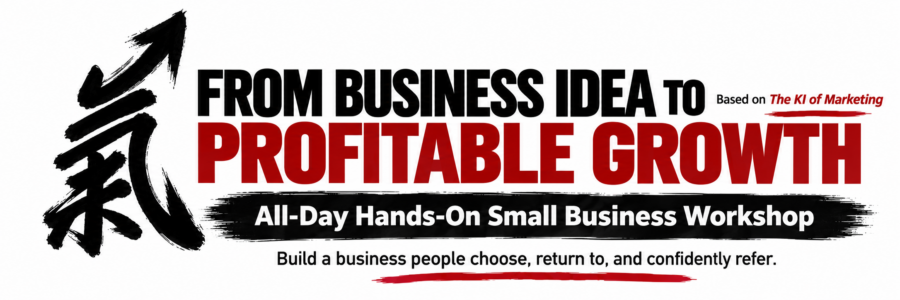
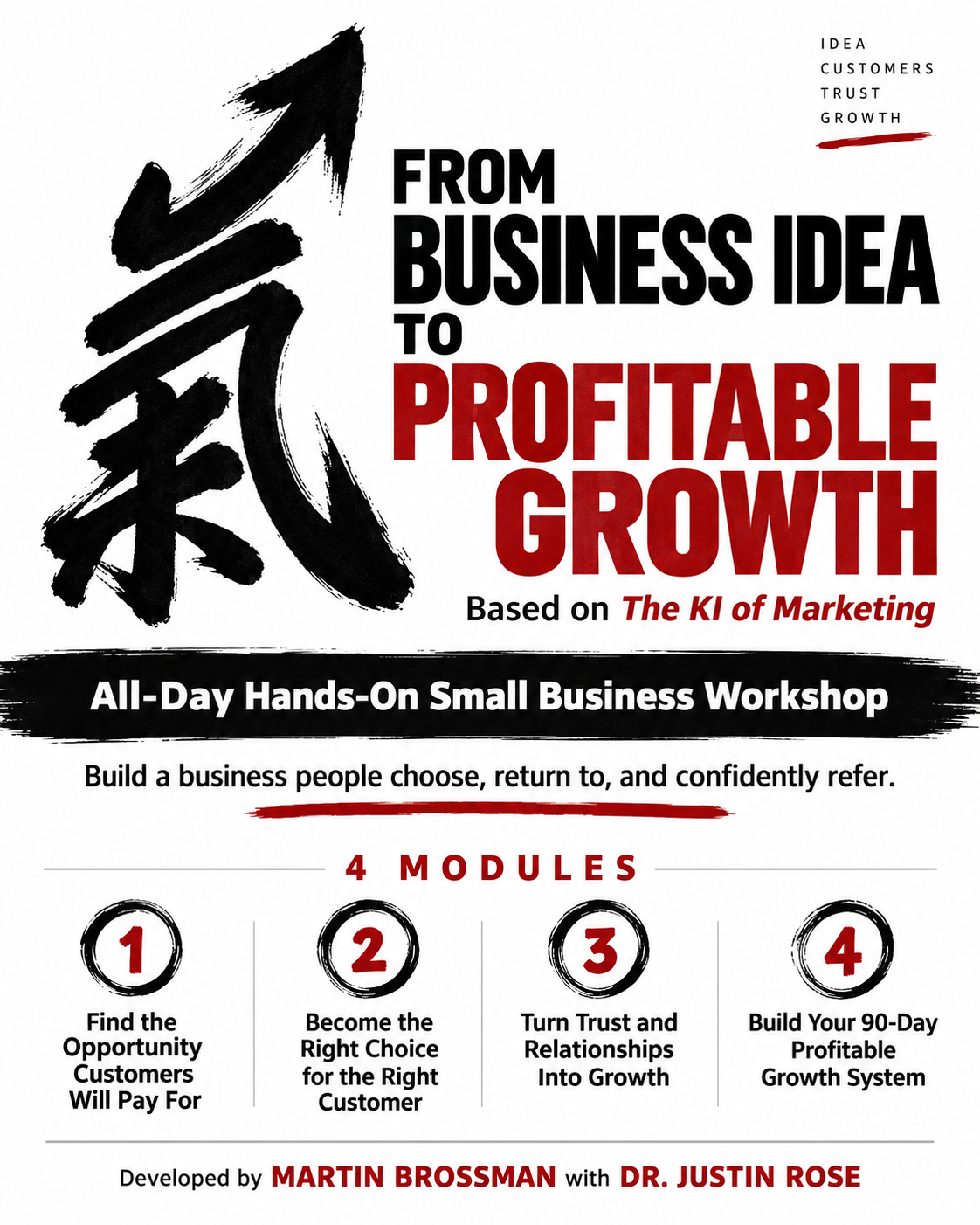
From Business Idea to Profitable Growth
Based on our book: The KI of Marketing: Go where your competition does not expect you and where your customers want you most.
Developed by Martin Brossman with Dr Justin Rose
All-Day Hands-On Small Business Workshop
How do you take a business idea and develop it into something people will pay for, return to, and confidently recommend, without assuming you have a large marketing budget? This hands-on workshop is designed for aspiring entrepreneurs, startups, and established small business owners who want to build or strengthen a business around real customer value, healthy revenue, strong relationships, and a marketing system they can sustain.
Based on The KI of Marketing book, participants will work through a practical path that begins with finding a problem worth paying to solve and ends with a 90-day rhythm for testing, measuring, refining, and anticipating what customers may want next. AI will be used only as a supporting tool for research, clarification, idea testing, and planning, while the foundation remains human judgment, customer behavior, relationships, and real-world results
Note: Arrangements for printed or PDF copies of the book are available at the end.
It is recommended that each module be 1.5 hr with a 10 min break and a 1hr and 10 min lunch.
A certificate of completion is optional.
Module 1: Find the Opportunity Customers Will Pay For
Participants begin by moving beyond the business idea itself and identifying the problem, frustration, desire, or outcome that customers value enough to pay to solve. They will learn how to listen for what is missing in the marketplace, including frustrations customers tolerate and the “wish they stopped making,” where an overlooked opportunity may already exist.
Participants will work on:
– What customers are actually buying, beyond the product or service
– Problems, frustrations, and desired outcomes worth solving
– What customers have tried before and what disappointed them
– Gaps competitors may be overlooking
-Customer behavior versus what people merely say they want
– The simplest way to begin testing an idea with real people
KI Steps covered:
- Find a Problem Worth Paying to Solve
- Listen for What Is Missing
Module 2: Become the Right Choice for the Right Customer
Participants will identify their “Only,” the combination of strengths, experience, personality, delivery, relationships, specialization, and customer experience that makes the business difficult to replace. They will then determine who receives the greatest value from that difference and test the offer through the Revenue and Referral Filter, asking whether people will actually pay for it and whether satisfied customers will confidently recommend it.
This module moves participants away from trying to appeal to everyone. New entrepreneurs can use the process to test assumptions before investing heavily, while established owners can identify poor-fit customers, weak offers, pricing problems, or areas where their strongest value has become invisible.
Participants will work on:
– Their current or proposed “Only”
– Several specific high-value customer types
– Customers the business may not serve well
– Why customers choose, return, and refer
– Whether an idea produces genuine buying behavior or only interest
– The Revenue and Referral Filter
– Making value easy for customers to explain to someone else
KI Steps covered:
3. Discover Your “Only”
4. Know Who Receives the Greatest Value, and Who Does Not
5. Put the Idea Through the Revenue and Referral Filter
Module 3: Turn Trust and Relationships Into Growth
Small businesses often have an advantage that larger competitors cannot easily buy: human connection, proximity, reputation, responsiveness, and community relationships. Participants will learn how to humanize the business, communicate the outcome customers receive, strengthen their Ground Game, practice the Champion Effect, and build referrals into the business instead of hoping word of mouth happens on its own.
The module then connects the Ground Game to the Web Game. Participants will examine how websites, Google presence, reviews, social media, video, educational content, and other digital tools can validate relationships already forming offline and help the right customers recognize that the business is a good fit.
Participants will work on:
– Communicating outcomes instead of only features and processes
– Making the real people and expertise behind the business visible
– Potential referral partners and complementary businesses
– Appropriate competitors who may become category allies
– The Champion Effect and local business relationships
– How to describe a good referral
– How to respond to referrals and close the loop
– What customers should find when they look the business up online
– Using digital content to attract better-fit customers rather than simply more attention
KI Steps covered:
6. Humanize the Business and Communicate the Outcome
7. Build Your Ground Game and Become a Champion
8. Make Referrals Part of the Business from Day One
9. Let the Web Validate and Multiply the Relationship
Module 4: Build Your 90-Day Profitable Growth System
Good marketing cannot depend on motivation or random bursts of activity. In the final module, participants turn what they have discovered into a practical 90-day operating rhythm built around a manageable number of actions, meaningful measures, customer feedback, relationship activity, and regular adjustment.
Participants will also look beyond revenue alone. A business can generate sales while still suffering from weak margins, poor pricing, excessive time demands, or costly customer acquisition. The goal is to identify which customers, offers, relationships, and marketing activities are actually helping create a healthier business.
Participants will work on:
– A focused 90-day business and marketing goal
– Weekly relationship and visibility commitments
– Customer follow-up and referral activity
– Meaningful measures such as conversions, referrals, repeat customers, average transaction value, margins, and profitability
– What to continue, stop, change, or test
– Where friction or drift is occurring
– How to keep listening for what customers may value next
– How to begin the next 90-day cycle based on real evidence
KI Step covered:
10. Build a Ninety-Day Rhythm, Measure What Matters, and Keep Listening
By the end of the day, participants will have the beginnings of a working growth system rather than a collection of disconnected marketing ideas. They will leave with a clearer problem worth solving, defined customer types, a working “Only,” a Revenue and Referral diagnosis, potential referral and community partners, a Ground Game and Web Game strategy, meaningful business measures, and a focused 90-day action plan.
This four-module structure also creates a strong progression: find the opportunity → become the right choice → build trust and referrals → create a repeatable growth system. It gives each section a distinct purpose while keeping the entire day connected to the central KI idea of recognizing where value, trust, relationships, and customer demand are already moving.
To schedule this training, contact Colleen@martinbrossman.com
Back to the list of trainings.